Process
Sketch before you pixel
Why every project I take on starts with a pencil, and how ten minutes of rough sketches can save weeks of polished mistakes.
 Mara EllisonProduct designer & front-end developer · 2 min read
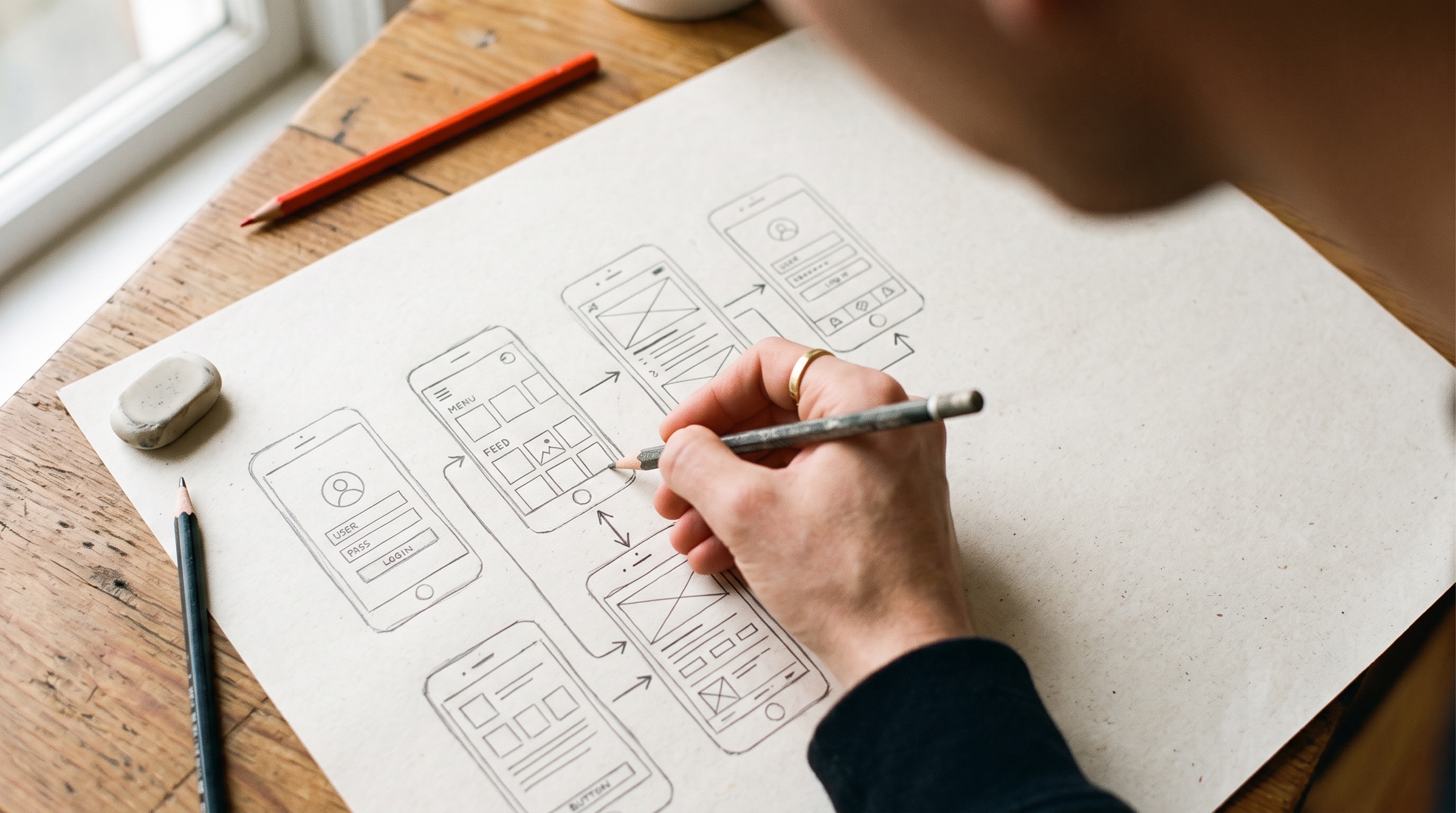
Every project I take on starts the same way: a stack of cheap paper, a soft pencil and a timer set to ten minutes. Before anyone opens Figma, we sketch.
It can feel old-fashioned, especially to teams who are used to moving straight into high-fidelity screens. But after ten years of designing and building products, it's the one habit I'd least like to give up.
Polish is persuasive, and that's the problem
A polished mockup looks finished. It has real colours, real type and real-looking data, so people react to it as if the decision has already been made. Feedback drifts towards the button colour and the copy, and the big question, whether this is the right thing to build at all, never gets asked.
A sketch has the opposite effect. It is obviously unfinished, so everyone feels free to question it. Engineers point out the edge case nobody had thought about. Someone from support remembers the customer who would get lost on step two. The conversation stays on structure and flow, which is exactly where it belongs at this stage.
The cheapest moment to change your mind is before anything looks finished.
Quantity first
When I sketch with a team, the goal isn't one good idea. It's twenty rough ones. I often run a quick round where everyone draws eight versions of the same screen in eight minutes, one minute each. Most of them are bad. That's the point. Ideas get better by comparison, and you can only compare what's on the table.
By the end of a session we usually have a wall of sketches, a few clear favourites and, just as useful, a list of approaches we've ruled out and why.
How I run a sketching session
- Start with the problem, not the screen. Read the brief aloud and agree on the one thing the user needs to get done.
- Set a timer. Short, strict rounds stop anyone from polishing.
- Draw alone, then share. Sketching in silence avoids groupthink, and talking through the sketches afterwards is where the good ideas collide.
- Vote with dots. Everyone gets three stickers to mark the parts they like, which surfaces patterns quickly without a long debate.
- Photograph everything. The sketches become the first page of the project's history.
From paper to prototype
Sketches don't replace prototypes, they make them better. Once we've chosen a direction on paper, I move to rough wireframes and then to a clickable prototype we can test with real people. Because the big structural questions are already settled, the prototype can focus on the details that only show up on a screen: motion, density and the feel of a real interaction.
On the Atlas Mobility charging app, our first sketching session produced the idea that eventually shaped the whole product: drivers care more about certainty than distance. It took ten minutes and a marker pen. Finding it in a polished mockup would have taken weeks.
Try it on your next project
You don't need to be good at drawing. Boxes, lines and arrows are enough. Next time you're about to open a design tool, set a timer for ten minutes and sketch three different ways to solve the problem first. I'd be surprised if the one you end up building is the first one you drew.
Written by
Mara Ellison
Product designer & front-end developer based in Lisbon, Portugal. Booking new projects for January 2027.